




As organizations invest heavily in artificial intelligence, one of their most valuable digital assets is often overlooked: the AI model itself.
While much of the conversation around AI security focuses on protecting sensitive data and preventing malicious outputs, another critical question deserves attention: What happens when someone gains unauthorized access to the model an organization has spent significant resources developing?
For businesses building proprietary AI capabilities, model confidentiality is becoming an important dimension of intellectual property protection, competitive advantage, and long-term AI security.
Why AI Models Are Becoming High-Value Assets
An AI model is more than a collection of algorithms.
Developing a proprietary model can require substantial investments in computing infrastructure, specialized expertise, data preparation, training, and continuous optimization.
Consider a financial institution that fine-tunes an AI model to detect sophisticated fraud patterns or a manufacturer that develops a predictive maintenance model using years of operational experience.
In both cases, the resulting model may capture valuable knowledge, patterns, and capabilities that competitors cannot easily reproduce.
The real value is not simply the technology behind the model, but the proprietary knowledge and competitive advantage it represents.
That value can extend beyond fully proprietary foundation models. Fine-tuned models, specialized adapters, and other customized model components may also contain commercially sensitive intellectual property.
Unlike traditional physical assets, however, digital models can potentially be copied and distributed without depriving their original owner of access.
If an attacker obtains a proprietary model’s weights, they may be able to reproduce its capabilities, operate it independently, or redistribute it without authorization.
The consequences go beyond the cost of developing a replacement. Model theft can undermine licensing models, expose proprietary capabilities, and erode the competitive advantage organizations have invested in building.
Model Confidentiality: An Emerging AI Security Priority
As enterprise AI adoption accelerates, models increasingly move between development environments, storage platforms, cloud infrastructure, and production systems.
Every transition introduces potential exposure.
Model weights, training checkpoints, and deployment artifacts may be stored in repositories, shared across teams, or accessed by automated deployment pipelines. Weak access controls, compromised credentials, or insufficiently protected storage can create opportunities for unauthorized copying.
But model theft is not limited to direct access to model files.
Attackers may also attempt model extraction, systematically querying an accessible AI service to approximate the behavior of a proprietary model without obtaining its original weights.
These are different attack scenarios, requiring different security controls.
Protecting the underlying model artifacts requires strong encryption, access management, and secure key handling. Defending against extraction through inference interfaces additionally requires measures such as authentication, rate limiting, and monitoring for suspicious usage patterns.
This distinction matters because securing the infrastructure where a model is stored does not automatically secure every way the model can be accessed or exploited.
Encryption Matters. Control Over the Keys Matters Just as Much.
Encryption is a fundamental safeguard for proprietary AI models.
By encrypting model artifacts, organizations can reduce the risk that unauthorized access to storage, backups, or repositories leads directly to exposure of the model’s contents.
However, encryption alone is not sufficient.
The effectiveness of encryption depends on how cryptographic keys are protected, managed, and accessed.
If attackers compromise both the encrypted model and the credentials or keys required to decrypt it, the protection can be defeated.
This is where hardware-backed key protection and centralized key management become particularly important.
Hardware Security Modules (HSMs) provide a tamper-resistant environment for protecting sensitive cryptographic keys and performing security-critical cryptographic operations.
Combined with a Key Management System (KMS), organizations can establish centralized control over encryption keys, manage their lifecycle, and enforce policies governing their use.
For AI model protection, this can help organizations separate key management from the infrastructure hosting their models, limit access to authorized services, and maintain records of cryptographic operations.
Digital signatures, backed by securely protected signing keys, provide another important safeguard: verifying that a model artifact has not been altered or substituted before deployment.
Together, these capabilities help establish a stronger foundation for model confidentiality and integrity.
There is, however, an important distinction: protecting a model at rest does not automatically protect it during execution.
Once decrypted for inference, model weights may be exposed within the computing environment. Protecting them during use requires additional safeguards, potentially including confidential computing, workload isolation, and strong runtime access controls.
Effective model security therefore depends on combining cryptographic protection with a broader, layered security architecture.
Establishing Cryptographic Control with Utimaco
At Utimaco, we believe that protecting valuable AI assets starts with establishing control over the cryptographic keys that secure them.
Utimaco General Purpose Hardware Security Modules (GP HSMs) provide hardware-backed protection for sensitive cryptographic keys, while Utimaco Enterprise Secure Key Manager (ESKM) enables centralized management and governance of encryption keys across enterprise infrastructure.
Together, these technologies can support secure AI architectures in which organizations maintain greater control over the keys protecting their models, training datasets, and other sensitive assets.
This approach is particularly relevant as AI workloads become increasingly distributed across on-premises infrastructure and cloud environments.
For example, Utimaco’s integration with the VAST AI Operating System enables centralized management of encryption keys used to protect AI datasets, models, and workloads, while maintaining separation between the keys and the data they protect.
Such architectures help organizations strengthen their security posture without relying solely on the security controls of individual infrastructure platforms.
The objective is to establish a consistent cryptographic foundation that can support model protection as AI deployments scale.
Protecting the Competitive Advantage Behind AI
As AI becomes more deeply integrated into business operations, protecting models will increasingly become part of protecting an organization’s intellectual property.
This requires a broader perspective on AI security.
Organizations need visibility into where proprietary models are stored, who can access them, how encryption keys are managed, and whether the models deployed in production are authentic and authorized.
They also need to recognize that no single security technology addresses every model theft scenario.
Encryption and hardware-backed key management help protect model artifacts and cryptographic assets. Digital signatures support model integrity. Runtime security and inference access controls address threats that emerge when models are deployed and used.
Ultimately, protecting an AI model means protecting the investment, expertise, and business value behind it.
Organizations that treat model confidentiality as an integral part of their AI security strategy will be better positioned to safeguard their innovations as AI adoption continues to grow.
Secure Your AI Models with a Trusted Cryptographic Foundation
As proprietary AI models become increasingly valuable, establishing strong cryptographic control over the assets that power them is essential.
Discover how Utimaco General Purpose HSMs and Enterprise Secure Key Manager can help strengthen the protection of AI models, sensitive data, and cryptographic keys across your AI infrastructure.
Explore Utimaco’s GenAI Security solutions and take the next step toward securing your AI ecosystem.

Prêt à assurer votre avenir numérique ?
Rejoignez plus de 500 entreprises mondiales et institutions gouvernementales qui font confiance à Utimaco pour leur infrastructure de sécurité critique.
Contacter le service des ventesYour download request(s):

Your download request(s):
About Utimaco's Downloads
Visit our Downloads section and select from resources such as brochures, data sheets, white papers and much more. You can view and save almost all of them directly (by clicking the download button).
For some documents, your e-mail address needs to be verified. The button contains an e-mail icon.
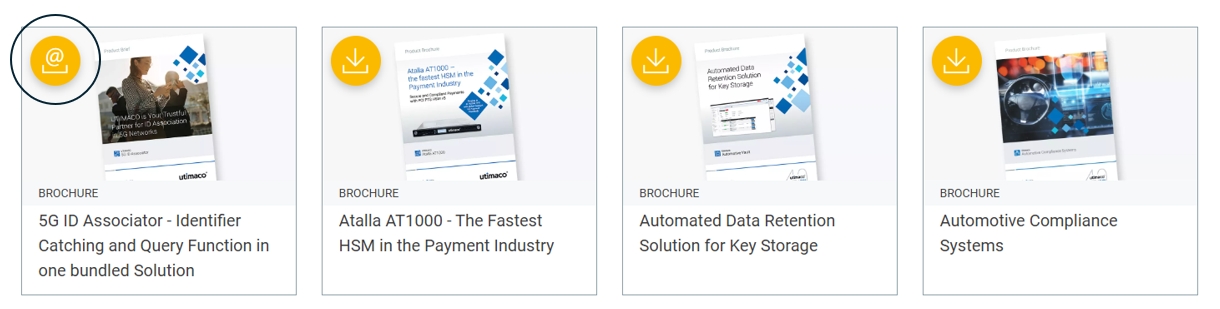
A click on such a button opens an online form which we kindly ask you to fill and submit. You can collect several downloads of this type and receive the links via e-mail by simply submitting one form for all of them. Your current collection is empty.